Friday, July 3, 2009

0
comments
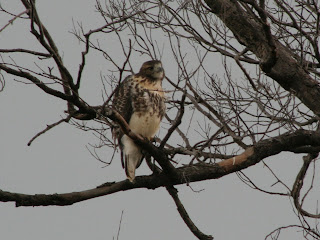
Red-tailed Hawk Fledglings

Two Red-tailed Hawks fledged earlier this week. Below is a sound clip of the vocalizations they were making to their parents who were sitting on telephone poles a hundred yards away.


Wednesday, July 1, 2009

0
comments
The Usual Characters

The Yellow-crowned Night Heron has been hanging around again lately. He's found a spot where the fishing must be good because he's been there the last three days searching for food in the same place.


Today he had a friend watching his back. A Spotted Sandpiper was "spotted" behind the heron running up and down the bank in search of food. Having completed his breeding obligations up north he is back on his way south to his wintering grounds. It is amazing how quickly they finish their business and head back south.

Wednesday, June 24, 2009

1
comments
Tids and Bits

Herons are beginning to be present in large numbers at the landfill. The usual Great Blue Herons are around, along with equal numbers of Great Egrets and Black-crowned Night Herons. There are still a few Green Herons around but they have become less common since May. And then there is the one Yellow-crowned Night Heron we see from time to time. The recent rain has filled up most of the wet areas on the landfill to the highest level I have seen them. The Melco Basin is completely full right now with little area for herons to search for food. This time last year the water levels were so low it all but dried up. The herons feasted on the dead carcasses of carp that were left out to dry.

Great Egret

I was able to snap some picks of this funky looking bird I think is an immature European Starling with interesting white patches on its body and wings. I'm not exactly sure what this coloration is called (leucistic?) but he was interesting none-the-less. He seemed slower than the rest and didn't respond when I played the distress call to disperse the birds. Due to his slowness and coloration I doubt I will see this bird again.

Common Grackle

I found this female Hooded Merganser on one of the ponds near the flooded woodland. She was slowly drifting down the pond occasionally diving down for food, oblivious to the loud wood chipper turning yard waste into compost and landfill cover less than a hundred feet away.

Hooded Merganser

Finally, the other night I found a large group of Wood Ducks on yet another pond. The pond was about as far away from the flooded wetland woods as could be. I counted in total 20 birds on this one pond. Around eight females were sitting on the bank and I saw atleast two females with broods following behind them like the birds below. Only one adult male was in the group and he was molting with many pin feathers covering his face. It was a pretty strange sight to me. The most Wood Ducks I have seen at once was two in a flooded woodland. I doubt I will see 20 again in the middle of an open pond anywhere else except the landfill. It is nice to know that despite being in such an urban area, even Wood Ducks are able to raise a brood.
Wood Duck

0
comments
Horned Lark Photo Shoot

There are a group of Horned Larks at the landfill, the most I've seen at one time is around five. I don't notice them until the place closes and all the trucks and bulldozers are gone. Then they start singing and feeding on the roadsides the trucks use during the days. Most of the roads are gravel and I see them picking up bits of seeds and grit. The males like to find a nice rock to stand on and sing their tinkling song to nearby females.


It's nice to see Horned Larks back at the landfill. During the ice storm in January a group of 200+ showed up on the landfill along with Snow Buntings and a Lapland Longspur. They were at the top feeding frantically on trash and whatever they could find exposed on the roads. Any place that wasn't covered in ice or snow had a Horned Lark on it looking for bits of food. Perhaps the smartest birds found a place under the pair of flares on the landfill that burn the methane generated by the decaying trash. The place was freshly seeded with grass which probably helped a good number of Horned Larks and Snow Buntings make it through the winter. The heat coming off of those flares is considerable and provided a nice warm spot in the chaos created by the winter storm.

Wednesday, June 17, 2009

1
comments
When Breakfast Bites Back

My co-worker Brian caught this sequence of a Yellow-crowned Night Heron fishing. He caught a big tasty snack but got pinched in the process.

Sunday, May 31, 2009

0
comments
Landfill Wildlife

Birds are not the only animals of interest on the landfill. To my surprise, there are a lot of different varieties of turtles and they are quite numerous. Along every drainage ditch there are at least a couple dozen turtles sunning themselves on the bank or hanging out in the water with just their snouts poking out. It is difficult to get a good look at them at times because they slink into the water when the truck approaches.

Red-eared Slider

Smooth Softshell Turtle

Snapping Turtle

There have been a variety of snakes seen as well, such as: Black Racer, Black Kingsnake, and a Northern Water Snake cruising down the same ditches holding all the turtles. Five-lined Skinks are numerous around the wooded parts of the landfill on fallen logs.

Black Racer

Five-lined Skink

There have been other cool sightings that have not been captured on film unfortunately. There is a resident Red Fox that has been seen a couple times. The last time I noticed him he was walking along the hill where we had traps set out to sample small mammals. I assumed he was walking that hill looking for an easy meal. I don't know how much luck he had because we barely caught anything, or maybe we the fox was just robbing the traps before we could get to them.

There are aquatic critters too...though not as many as there used to be. The beaver population is dropping because Brian (my supervisor) has had to kill five because they keep building up dams and flooding the equipment on the landfill. It is amazing how high they can build those dams up in such little time. Muskrats are also present in the wetlands along with the beaver. But perhaps the most interesting find so far on the landfill was a River Otter. After we had extended periods of rain in mid May, the wetlands and ditches were as full as I've ever seen them. I found the otter in what amounted to a drainage ditch with three feet of vegetation on each side, and he was snacking on something, possible a carp. I have since found out that there have only been 19 otter sightings in Jefferson County in the last three years, most of those records coming from trapping.

And just because I took this picture and wanted to share.

Blue Grosbeak

Saturday, May 16, 2009

0
comments
White-crowned Sparrow

White-crowned Sparrow

Related Posts Plugin for WordPress, Blogger...
Twitter Delicious Facebook Digg Stumbleupon Favorites More